
How About Walking Down to the Bottom of a Well With Your Bucket to Fetch Water?
Prepared by Andrew Stone, Hydrogeologist (andrewstonewater(at)gmail.com)
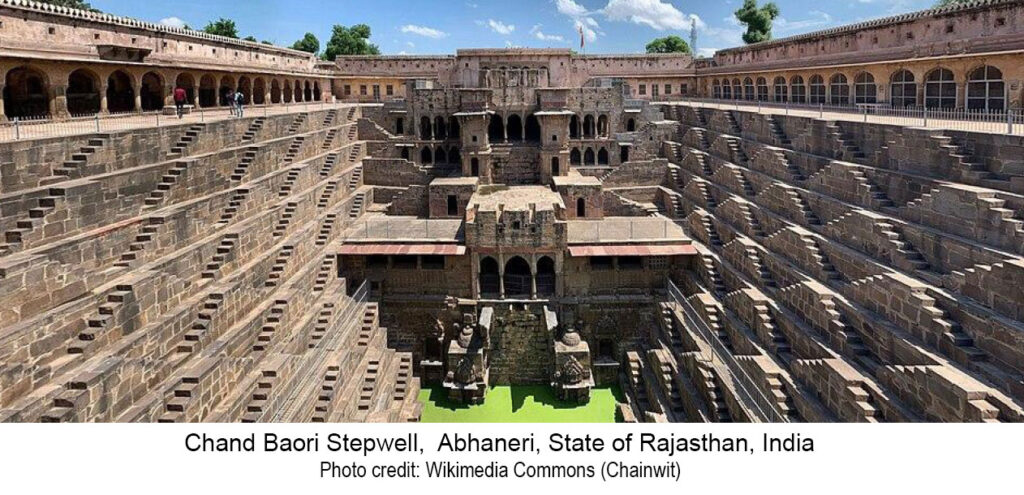
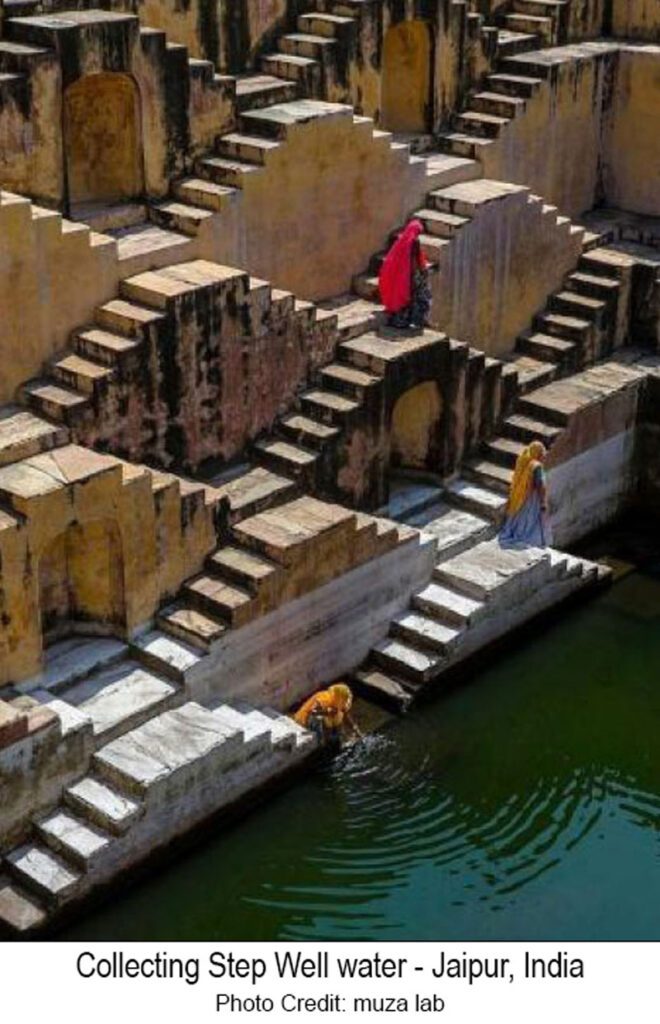
Did you know that there are over 3,000 stepwells in India with many others in arid countries? Water wells are typically constructed or drilled as simple vertical shafts. However, a stepwell is a large diameter excavation constructed to reach permanent groundwater. Access to the wellwater is via a series of stone steps down from the surface to the well water. At a time of low groundwater, it takes several staircases of steps down to reach the water level.
Locally known in India as baoli, the primary purpose of stepwells is to provide year-round availability for water, especially in arid and seasonally arid areas. To make groundwater available year-round stepwells are excavated to a depth just below the lowest expected groundwater level (water table). Steps in a series
of staircases allow people to walk down to reach the water. As the groundwater level rises in the well,
(in India, often as a result of seasonal monsoon rains) the lower steps become submerged and less staircases are used to reach the water.
The picture above shows the 100 ft deep Chand Baori stepwell. (The green color is the water!). The well was constructed in the 8th and 9th century and has a total of 3,500 steps in thirteen levels of stone staircases.
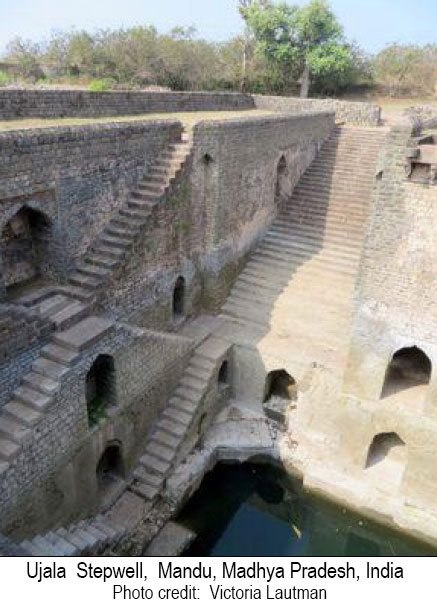
The picture on the left is of the 15th/16th century stepwell called Ujala. It has a less-complex design than Chand Baroi but operates on the same principle.
Stepwells had the primary secular purpose to supply water. However, over the centuries many took on additional significance that led to elaborate architecture and carvings to honor different religions and to give recognition to the dynasties and sultan rulers who financed the stepwell projects.
Still on the subject of history, during the 19th century when India was part of the British Empire, stepwells were decreed by colonial authorities to be unhealthy, and water supply was provided by drilled wells. Many stepwells were then closed and some were filled in, fell into disrepair or became dumps.
Fast forward to the 21st century, and with increasing population, increasing aridity and monsoonrain uncertainty, water managers in India have to consider all options. Many stepwells in India are now being cleaned out and recommissioned to augment supply sources. For example, groundwater is now restored as a supply source at stepwells in Jodhpur (Toorji ka jhalra stepwell) and in Rajasthan, (Moosi Rani Sagar stepwell).
Search the web for many sources of more information about these fascinating constructions that access groundwater. Wikipedia is a good starting point. Also, visit Stepwell Atlas for an interactive map of world stepwells. [Note – the two stepwells listed in the United States don’t function as traditional stepwells!]
Picture of the month prepared by Andrew Stone, Hydrogeologist, andrewstone@gmail.com
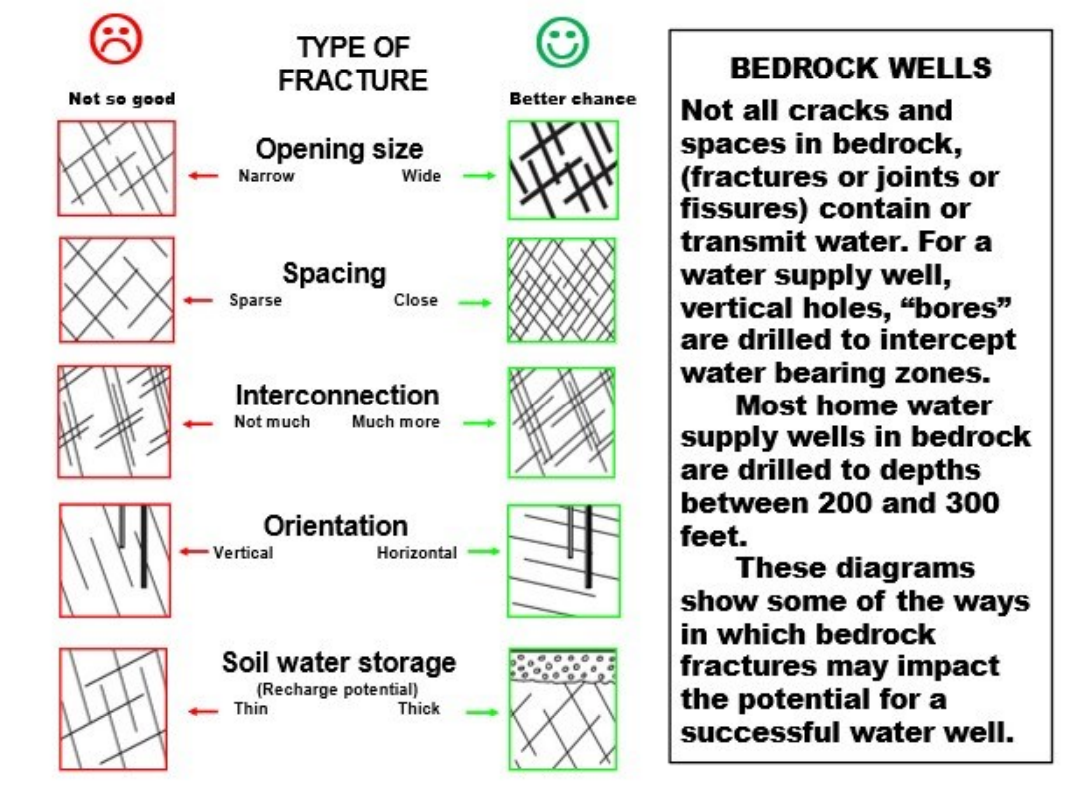
WELLS IN BEDROCK FRACTURES
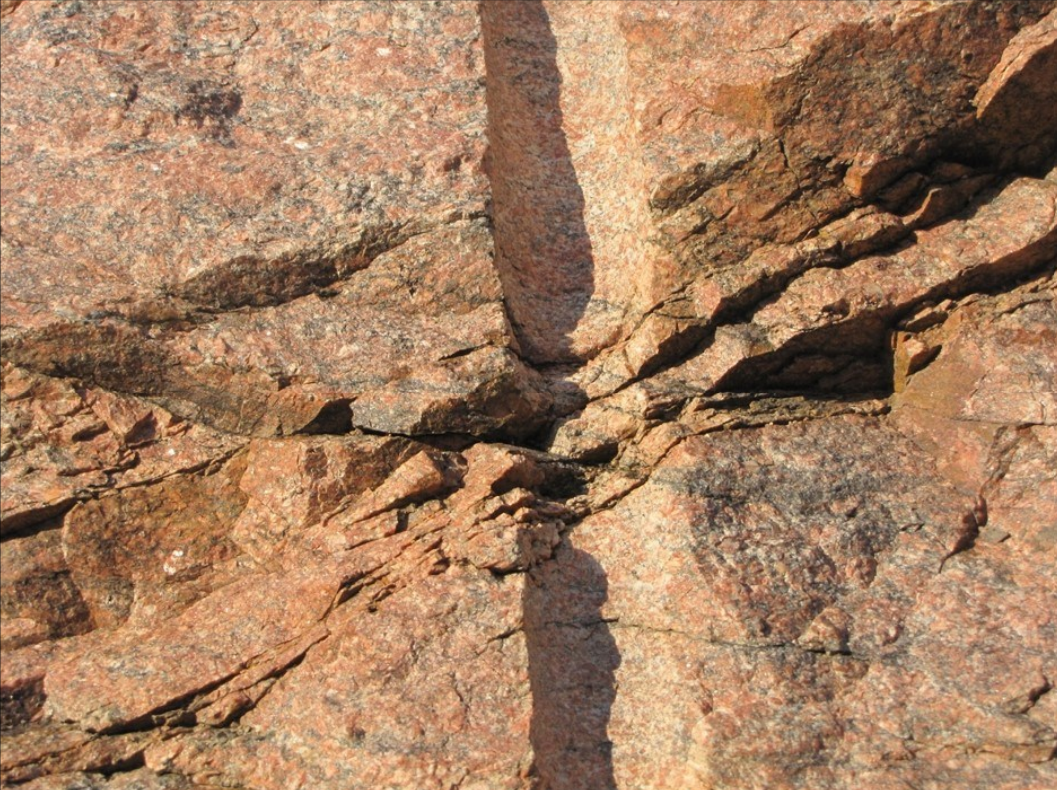
How often do you get to see a cross-section of what was until very recently a subsurface drill hole intercepting a bedrock fracture?
The photo of 1.4 billion old Silver Plume granite was taken on the I-70 frontage road in Mount Vernon Canyon just west of Golden, Colorado.
Photo Credit: Peter Barkmann, Colorado Geological Survey
The photograph shows a now exposed section view of a drill hole intercepting bedrock fractures in granite bedrock. When occurring below the water table, saturated fractures in bedrock can transmit and store water. To be successful, a bedrock well should intercept saturated fracture systems that are interconnected. In many cases, fracture systems that are connected to recharge zones, such as overlying layers of sediment, have the best chance of producing a reliable sustainable yield. There are millions successful bedrock wells providing water to homes, farms and businesses throughout the USA. Some bedrock wells have limited connection to groundwater and yield may decline seasonally or in times of drought. Aerial imagery and geophysical techniques can be effective in identifying the orientation and density of fractures and optimizing the chances of selecting a site for a successful water well.