

January 6, 2026
“Jack and Jill went up the hill to fetch a pail of water,
Jack fell down and broke his crown and Jill came tumbling after”
Prepared by Andrew Stone, Hydrogeologist (andrewstonewater(at)gmail.com)
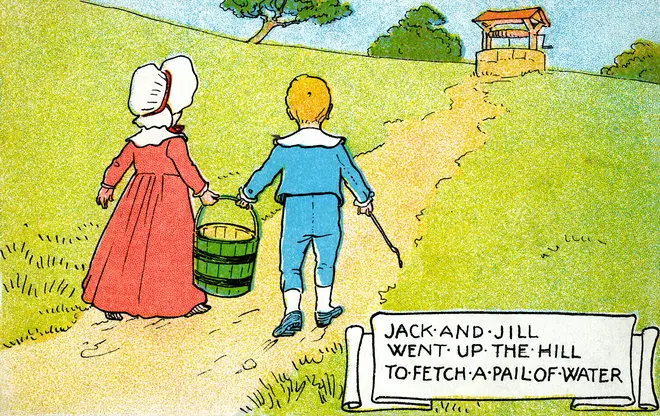
What! – that first line is a great groundwater learning opportunity!
Have you ever realized that for many generations of young children the well-known Jack & Jill nursery rhyme, published in 1795, serves as their first introduction to groundwater! The rhyme provides four subliminal water resources messages:
1 Illustrations of the rhyme typically depicted a well with a rope and bucket. The message: there is water down the well, hidden in rocks and earth below ground level, (groundwater).
- To get the water out of the well there has to be some way to raise the water up to the surface.
In this case, a rope connected to a handle that works by muscle power. [Many 18th and 19th century illustrations show Jack & Jill as young children. However, even if they could reach the handle, lifting the bucket up the well is probably more than small children can manage!]
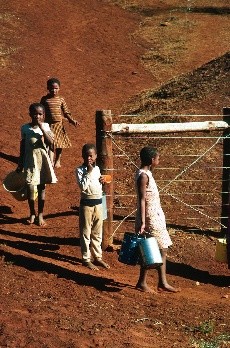
3.Once out of the well and into the bucket, the real work begins because the (heavy) water has to be carried (without spilling) from the well to the home. [For many, but not all, communities worldwide, pumps have transformed the chore of getting groundwater out of the well.]
4.Two-person teamwork may be needed when carrying a heavy bucket to ensure that the precious water arrives safely. [Pipelines have revolutionized “fetching water” although UNICEF reports that 2.1 billion people worldwide do not have access to safely managed water. Children often have “fetching” responsibility.]
The first line of the rhyme has relevance from a water perspective. There are also interesting backstories about the rhyme’s origins and meaning. The names Jack & Jill were typically used in the 16th century as generic names for a man and a woman or boy and girl. Shakespeare uses the names in the plays, A Midsummer Night’s Dream and Love’s Labor’s Lost.
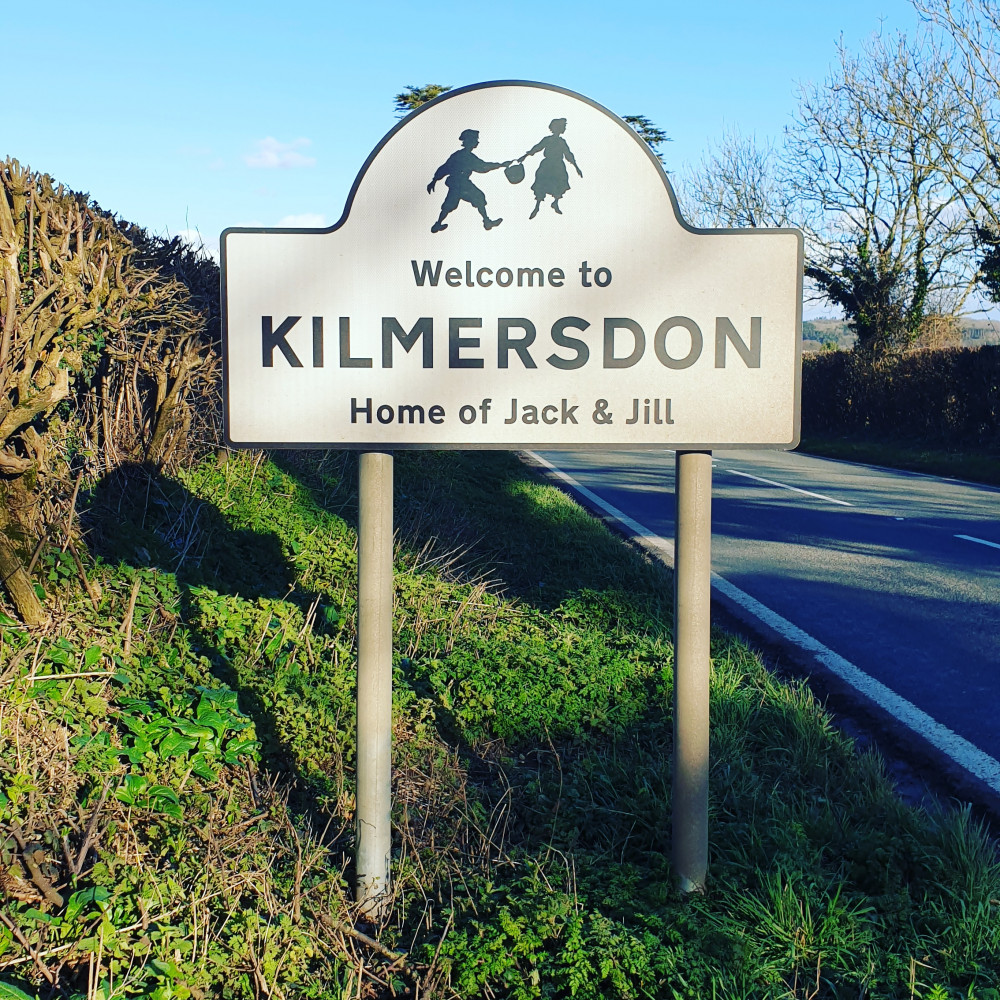
The village Kilmersdon in western England claims to be the place where the rhyme originated. The village has a road sign claiming “ownership.” A local historian, Martin Horler, researched the folklore and gives a date of 1645, when according to legend, Jack and Jill (who are teenagers) climb a local hill called Badstone, and in a quarry at the top, a boulder falls and crushes Jack (broke his crown) and two days later the disaster is compounded when Jill dies in childbirth (came tumbling after). This disaster, (if true and the date accurate!) took place 150 years before the first known publication of the nursery rhyme, giving plenty of time for the words retelling the tragedy to be transformed. The water well origins of the story received supporting evidence in 1999 when an old well was discovered on the top of Badstone Hill in Kilmersdon. This gave the village “proof” that their claim to the origins of Jack & Jill was correct. Archaeologist Dr. Peter Addyman confirmed the 35 foot deep well’s 16th century origins and Kilmersdon doubled down on their claim to be the home of the Jack & Jill story.
A French claim to the rhyme’s origins is that the rhyme, (Jack et Jill la colline ont monté), originates from France’s Revolution. The words describe the demise of King Louis XVI who was guillotined in1793 (broke his crown) and his wife Marie Antoinette, who was beheaded the following year (came tumbling after).
Yet another suggestion of the rhyme’s meaning is that is satirizes England’s King Charles I, who in the 17th century tried to raise money by reducing (“tumbling down”) the volume of a Jack (1/8 pint), of beer or wine while keeping the same tax. The size reduction the gill (1/4 pint) would then come “tumbling after,” (Jack & Gill)
As is the case with many nursery rhymes, the origins of tragedy: “rocks crushing heads” “kings and queens beheaded” “raising taxes on drinks” may refer to real occurrences that are retold in a gentler form.
More Information
- The true meaning of dozens of nursery rhymes is documented and speculated in many publications, for example:
the book “Pop Goes the Weasel, The Secret Meaning of Nursery Rhymes” by Albert Jack, 2009, Penguin Books. - For information about Kilmersdon’s claim to be the “home of Jack & Jill”, go to Wikipedia or any search engine.
- Visit UNICEF for information about global drinking water challenges - https://www.unicef.org/wash/water-scarcity