

March 3, 2026
Bank Filtration - Nebraska Teachers Learn About Groundwater Supply
Is water from a well near a river actually groundwater?
Prepared by Andrew Stone, Hydrogeologist (andrewstonewater(at)gmail.com)

Photo credit: Andrew Stone
The photograph to the left shows water supply wells close to the Missouri River at Nebraska City, NE. The view from the bus was taken during an American Ground Water Trust field-trip training program for teachers. Water utility staff explain the engineering principle of bank filtration systems. Securing safe reliable water supply and having citizens educated about basic hydrology are both important objectives!
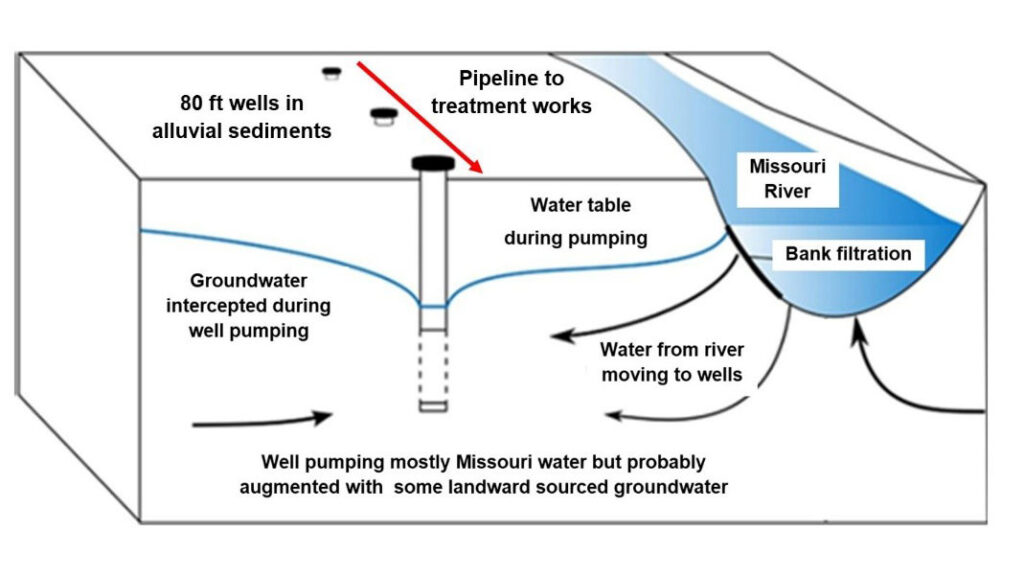
The wellheads of the riverbank wells are raised above flood level with their pumping equipment protected in the “sheds on stilts.” Flood waters typically have high turbidity and increased contaminants. Protecting wellheads is essential for the thousands of vertical wells or collector wells in alluvial sediments close to rivers. Some of the water pumped from riverbank wells may be groundwater that was naturally moving towards the river, but the bulk of water pumped from wells close to rivers is subsurface flow from the riverbed to the aquifer, induced when pumping lowers the water table.
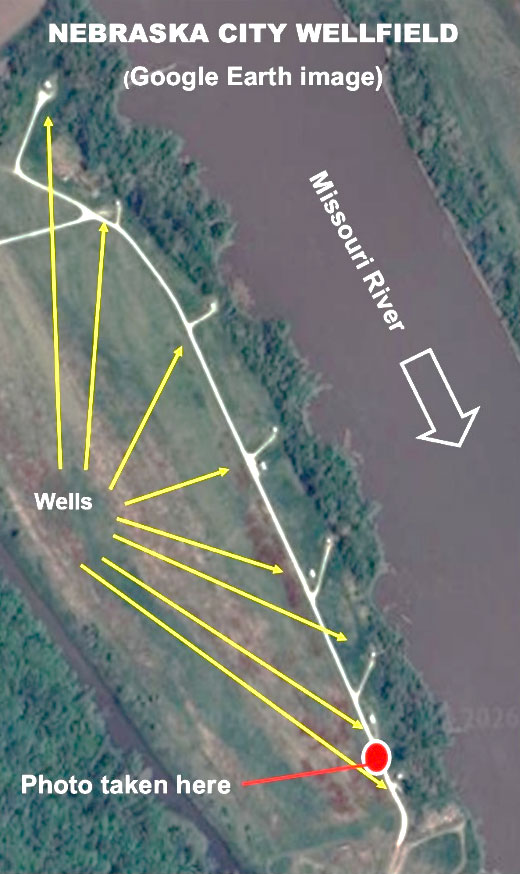
Riverbank filtration, sometimes called riparian groundwater, has been an accepted supply solution worldwide for millennia. Many high capacity systems installed in Europe in the 19th century are still in operation. The US has hundreds of large and small municipal systems that use bank filtration; for example, Louisville, KY, Des Moines, IA, Bismark, ND and Littleton, MA. Many riverbank systems use large diameter “Ranney” wells and some have horizontal well connections underneath the river. The eleven Nebraska City wells are vertical wells in alluvial sediments with a diameter of 18 inches and a depth of 85 feet.
Wells close to surface water are considered to have a risk of contaminants not usually found in true groundwater. The EPA has rules about the treatment of “groundwater under the influence of surface water.” However, water from alluvial wells near rivers requires much less treatment than water pumped directly from rivers. As water moves from the river to the well, chemical and biological processes in the aquifer remove pathogens, nitrogen, synthetic organic chemicals and pesticides resulting in treatment cost savings.
More Information
- RBFsim - A recent paper on Riverbank Filtration (RBF)
- Assessing RBF - Detailed technical information with over 100 references
- Whittman/Layne - Explanation of collector wells