

February 9, 2026
“Tides They Are A-Changin’”,…Groundwater,…Ghost Forests
Prepared by Andrew Stone, Hydrogeologist (andrewstonewater(at)gmail.com)
“Changin” sea levels are impacting groundwater along coasts, estuaries and tidal rivers.
Ghost forests provide dramatic visible evidence of changes in subsurface water quality.
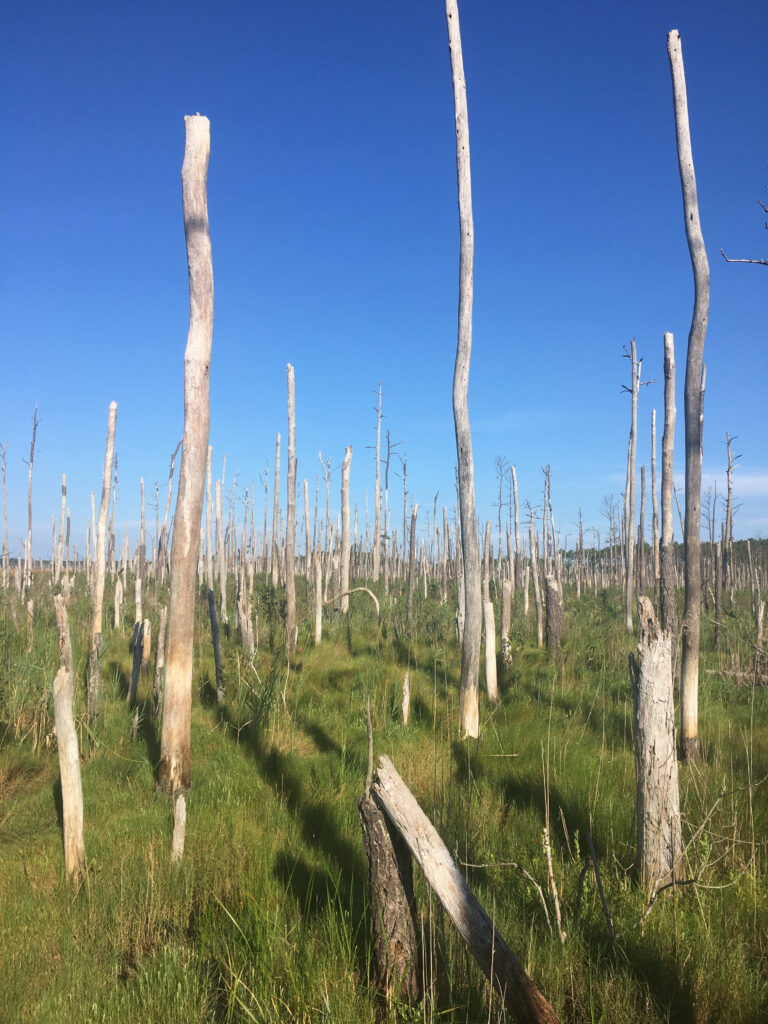
A “ghost forest” of dead trees refers to places where previously healthy trees have died because of increasing salinity in the root zone. The photograph (right) is from the Maryland coast where in places trees have died but remain standing. Rising sea levels can impact subsurface water quality by saline intrusion contamination. Some estimates show current global average sea level rise to be as much as 3mm/year, (about 1/8 of an inch). The dying of trees is a visible manifestation of future economic impacts on infrastructure that are likely to be much greater than the ecological loss of trees as ghost forests.
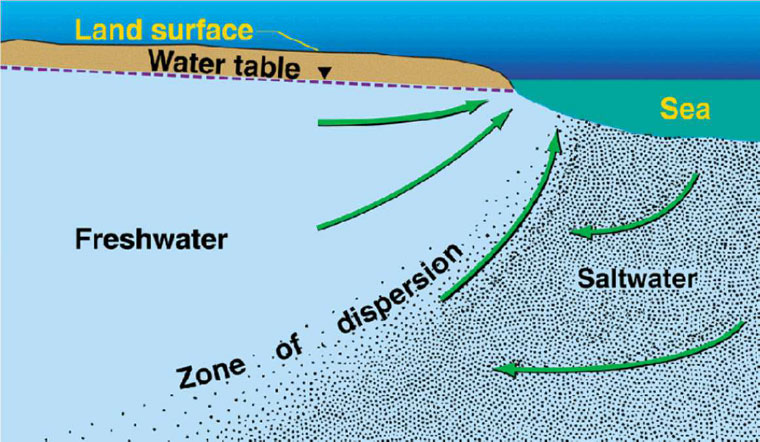
Basic physics and geology explain the intrusion process in coastal aquifers. The subsurface seaward movement of fresh groundwater can prevent saltwater from encroaching on coastal aquifers. The position of the saline/fresh interface in aquifers (zone of dispersion) involves a balance between gravity induced seaward groundwater flow and the sea level baseline. Coastal aquifers can occur in many geological environments provided there is enough interconnected permeability for hydraulic contact between land and offshore. The USGS diagram indicates that impacts of reduced groundwater flow and/or a rise in sea water level baseline will move the boundary zone between saltwater and non-saline water landward, causing saline contamination of groundwater or completely replacing what was preciously fresh groundwater. Storm surges and coastal flooding related to sea level rise can also exacerbate low-lying coastal salinity changes.
Over recent decades, sea levels worldwide have increased relative to the land. Why? A principal reason is rising global temperatures causing thermal expansion of seawater. Changing weather patterns are also increasing the rates of ice melting from the poles and mountain glaciers. In addition, decades of depletion of groundwater from aquifers has added to ocean volume. In some places, land subsidence or geological instability has locally accelerated the landward impacts of saline intrusion.
Some of the challenges for water-related infrastructure will require coastal communities to invest billions of dollars to mitigate the effects of increasing salinity of groundwater and rises in the level of water tables.
- Increasing salinity will result in the abandonment of wells for drinking water supply and irrigation.
- Even if salinity increases are small, there is increased risk of corrosion of pumps and equipment.
- Onsite septic systems could fail if rising groundwater levels impact leach fields in coastal homes.
- Saline seepage into municipal sewer systems could require new treatment processes or relocation.
- Landfills and low lying contaminated areas risk leachate generation from rising groundwater.
- Riparian saltwater intrusion from all tidal waters and any hydraulically connected drainage ditches
- and canals can bring salinity issues many miles inland from the coast.
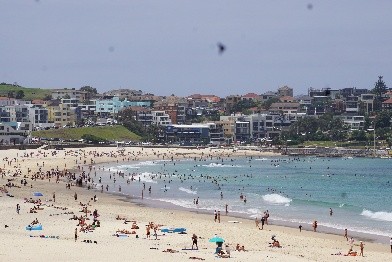
A huge engineering and planning response is needed for sea level changes affecting millions of citizens in low lying coastal cities. Policy procrastination may turn out to be very costly. Ghost forests are just one “canary in the coal mine” that has already fallen off its perch. It is not a time-distant risk. Has anybody noticed?
Next time you are relaxing on an ocean beach give some thought to what is happening at the saline freshwater interface below the beach, and ask yourself - where is the “zone of dispersion” and is it moving inland?.
More Information
- Ground Water in Freshwater-Saltwater Environments of the Atlantic Coast, USGS https://pubs.usgs.gov/circ/2003/circ1262/
- Saltwater intrusion and sea level rise threatens U.S. rural coastal landscapes and communities. Link Scholarly article: 2024, O’Donnell et.al.
- Special Report on the Ocean and Cryosphere in a Changing Climate, IPCC https://www.ipcc.ch/srocc/ (Chapter 4)